PLAN YOUR HIDDEN DOOR
Inswing or Outswing?
Swing direction determines which side of the doorway your bookshelf moves into when opened. The right choice depends on the clearance, layout and how you use the rooms on either side.

THE BASICS
What Do Inswing And Outswing Mean?
An inswing opens into the room behind the door, while an outswing opens into the room in front. Both options use the same bookshelf design and hardware — the key difference is the direction the door swings. On the opening side, an inswing has trim fixed to the wall, while an outswing has trim attached to the bookshelf so it moves with the door.
WHY DOES SWING DIRECTION MATTER?
A few things to consider
Because the entire bookshelf moves when the door opens, your swing direction can affect the space around the opening, furniture placement and how you move through the doorway.

CLEARANCE
Our bookshelf is 203mm deep, so allow at least 203mm clearance in the swing direction.

FURNITURE PLACEMENT
Consider furniture, cabinetry and other fixed elements on either side of the opening.

WALKWAYS
For an outswing, consider whether the bookshelf will open into a hallway or a frequently used walkway.

ROOM LAYOUT
For an inswing, consider how the open bookshelf will affect the usable space inside the room.
A CLOSER LOOK AT
Inswing Hidden Doors
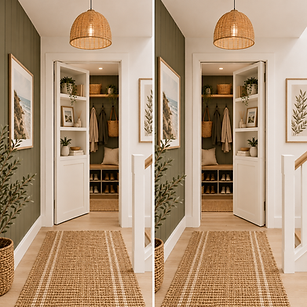
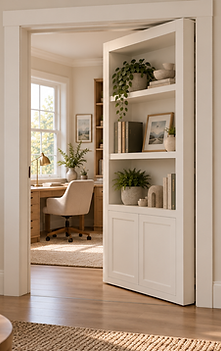
An inswing door opens into the room behind the bookshelf. As it opens the entire bookshelf moves through the doorway and into the concealed space.
A CLOSER LOOK AT
Outswing Hidden Doors
An outswing door opens towards the room you're standing in. The entire bookshelf swings outward toward you, rather than into the space behind.

You have clear space inside the room
The room behind is larger
You want to keep the space infront clear
There's no furniture in the doors swing path
You want to preserve space inside the room
The hidden room is smaller
You have clear space infront of the door
It wont open into a narrow hallway or walkway
HOW DO I CHOOSE?
Look at the space around your door
Before deciding, imagine your bookshelf fully open and ask:
01
Is there enough clear space for the entire bookshelf to move?
02
Is there furniture or cabinetry close to the opening?
03
Which direction makes entering and exiting the space feel most practical?
04
Would an inswing reduce the usable space inside the room?
05
Would an outswing open into a narrow hallway or walkway?
What Could Affect Your Swing Direction?

Nearby walls or corners

Furniture or cabinetry

Walkways and access

Light switches and power ports

Available Clearance

Layout of the room behind
KEEP PLANNING
What Would You Like To Explore Next?
Continue with another planning guide or head back to explore everything you need to consider when planning your hidden door.